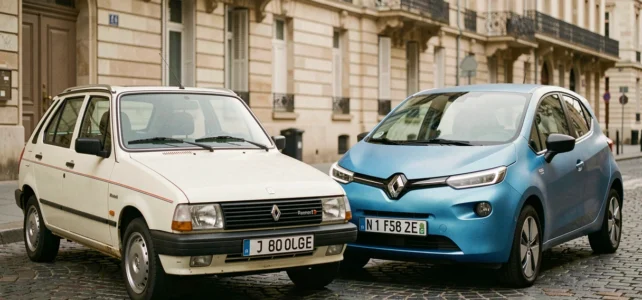
The R5 and the Super 5 share a name, a manufacturer, and a familiar silhouette, but they belong to two distinct technical generations. Their confusion persists because Renault deliberately maintained the stylistic lineage at the launch of the Super 5 in 1984. Here, we will detail the concrete differences in platform, mechanics, and usage that separate these two models.
Platform and chassis architecture: R5 based on R4, Super 5 on dedicated platform
The R5 is built on the mechanical base of the R4, featuring a floor with longitudinal beams and a rear suspension with longitudinal torsion bars. This architecture, designed for simplicity and cost, imposes a specific road behavior: soft but imprecise rear end in support. The four independent wheels use a minimalist scheme inherited from the previous decade.
The Super 5 introduces the X40 platform, later shared with the Clio I. We transition here from a utility-derived chassis to a modern automotive design, with significantly higher torsional rigidity. The rear axle with a deformable beam replaces the longitudinal torsion bars, radically changing cornering behavior and stability at high speeds.
This platform change is the fundamental turning point. Everything else, including engines, habitability, and equipment, stems from it. A comparison between the R5 and the Super 5 highlights this generational break that visual similarity tends to obscure.
Engines R5 and Super 5: from Cléon-Fonte to Energy block
The first generation R5 is equipped with Cléon-Fonte engines with a side camshaft. The base engine has a displacement of 782 cm³ with a real power output of 36 hp SAE. The gearbox has only four gears, with a dashboard control, a common solution in the 1970s but completely abandoned later.
The Super 5 adopts Cléon-Alu then Energy engines, with overhead camshafts. The difference in efficiency is notable: at comparable displacement, the torque available at low revs increases, fuel consumption decreases, and top speed rises. The gearbox control moves to the floor, with five gears on most versions.
The case of the sporty versions
On the R5, the Alpine and then Alpine Turbo versions introduce the turbocharged Cléon-Fonte engine, a bold graft on an old block. The R5 Turbo (and Turbo 2) goes further with a centrally mounted rear engine, an architecture unrelated to the standard R5.
The Super 5 GT Turbo receives the turbocharged C1J block, still in the front position. Its power-to-weight ratio and ease of tuning have made it a reference in amateur rallying. The GT Turbo remains the most sought-after version on the collector market, with values that have significantly increased in recent years.
Bodywork and interior differences between R5 and Super 5
At first glance, the Super 5 looks like a restyled R5. The design by Marcello Gandini (for the R5 phase 2) and that of Supercinq (signed by Giugiaro via Italdesign) share similar proportions, but the construction differs in several concrete ways:
- The R5 phase 1 exists only in three doors. The five-door version arrives mid-career and retains a narrow hatch. The Super 5 offers both configurations from launch, with a wider hatch and a more usable trunk opening.
- The windshield of the Super 5 is more inclined, improving the Cx and reducing aerodynamic noise. The drag coefficient decreases significantly compared to the R5, with a direct effect on fuel consumption at stabilized speeds.
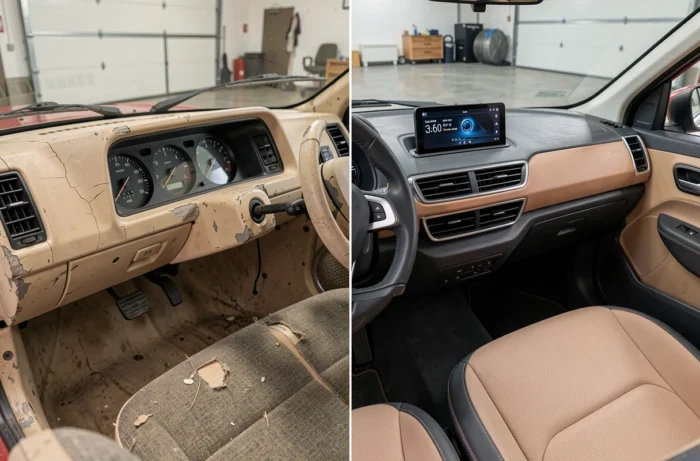
- The interior of the Super 5 gains in elbow width and trunk volume. The dashboard adopts a more conventional horizontal design, whereas the R5 featured a dashboard very typical of the 1970s.
R5 E-Tech electric: the third act of the name
The name R5 returned in 2024 in the form of the Renault 5 E-Tech, an electric vehicle with no technical link to the two historical models. The R5 E-Tech incorporates bidirectional V2L/V2G from the design stage, with a bidirectional AC charger of 11 kW on certain versions. This feature allows the vehicle to send energy back to the grid or a home.
The deployment of V2G reached a concrete milestone in 2026 with commercial rollout to individuals in the Netherlands, through a Renault/We Drive Solar/Hegg Energy partnership. We are no longer in the realm of marketing promises: users charge at night during off-peak hours and return energy during the day.
Bidirectional compatibility varies depending on the exact version of the R5 E-Tech (engine, battery capacity). The offering can no longer be treated as a homogeneous block: one must check the technical specifications of each configuration before purchase. The R5 E-Tech has also received a Euro NCAP rating of four stars, a safety aspect that the nostalgia for the R5/Super 5 face-off tends to overshadow.
Quick identification: R5 or Super 5 on the ground
For collectors or swap meet buyers, confusion remains common. Here are reliable markers:
- The manufacturer’s plate (on the right side of the engine compartment on the R5, on the left side on the Super 5) indicates the type number. R5s carry a type starting with R12xx, Super 5s with C40x.
- The dashboard gearbox control is exclusive to the R5. On the Super 5, the lever is always on the floor.
- The rear lights of the R5 phase 1 are vertical and narrow. Those of the Super 5 are horizontal, integrated into the hatch trim.
- The number of gearbox gears (four on most base R5s, five on almost all Super 5s) provides an immediate mechanical clue.
The R5 and the Super 5 embody two industrial eras of Renault, separated by a leap in platform, engine, and design. Confusing the two amounts to ignoring a decade of technical progress. With the return of the name in electric form, the lineage now spans three generations, each rooted in the constraints and technologies of its time.