
We’re preparing hummus, we’re starting a sesame sauce recipe, and when it comes time to look for tahini in the aisle, we’re going in circles. The jar is neither with the oils, nor with the canned goods, nor with the spices. Tahini has the particularity of being listed in almost all major French retailers, but is arranged differently from one store to another, sometimes even from one point of sale to another within the same chain.
Poorly placed tahini in supermarkets: the locations where no one looks for it
The classic reflex is to head to the world products aisle or the organic grocery section. In most cases, this is a good starting point. The problem arises when the jar is not there, which happens more often than one might think.
Several retailers classify tahini with nut butters (almond butter, peanut butter, hazelnut butter). This section is sometimes found in the middle of the sweet grocery aisle, sometimes at the end of the organic aisle, and sometimes next to dietary supplements. At Auchan, some stores place it near halal products, between hummus and oriental sauces.
We’ve also spotted references in exotic condiments, wedged between soy sauces and curry pastes. When tahini does not appear in the organic section or world products, that’s where you should look first.
If you compare the price of tahini at Leclerc, Intermarché, or Super U, you will notice that the arrangement also varies depending on the jar size and the brand distributed, which further complicates the location.
- Organic aisle or nut butters: the most common location, often near almond butter or whole sesame paste.
- World products aisle or oriental grocery: available at Carrefour and Auchan, sometimes near the halal section.
- Condiments or exotic sauces aisle: a secondary location that traps many customers, especially in large hypermarkets.
- Fresh deli section: a few stores position tahini next to refrigerated hummus, but this is rare and mainly concerns “ready-to-use” formats.
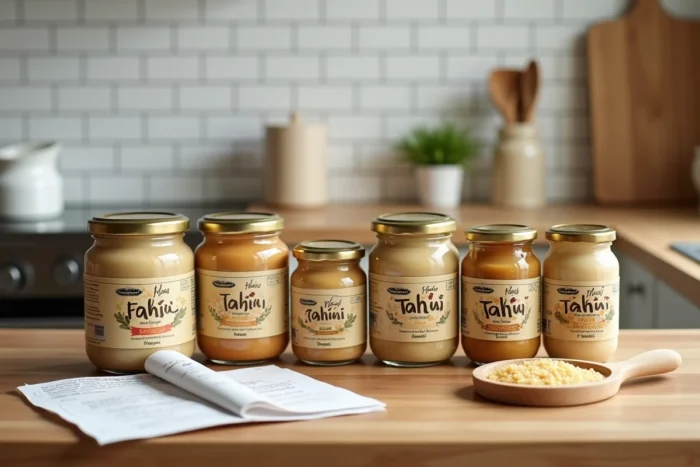
Tahini in supermarkets: which retailers and formats are available
Auchan, Carrefour, Leclerc, Intermarché, Super U, and Monoprix all list at least one brand of tahini or sesame paste. The presence on the shelf is confirmed online in the catalogs of these retailers, but the physical stock depends on the store. A Carrefour hypermarket will have more references than a Carrefour City.
Formats vary widely. You can find small jars of 125 g or 175 g, intermediate sizes from 200 g to 300 g, and 400 g bottles for heavy consumers. Some brands also offer squeezable soft containers, which are more convenient in the kitchen.
Common brands by retailer
At Carrefour, the Durra brand offers a 100% sesame tahini in a 400 g bottle. At Auchan, Al’Fez is often listed in the world products aisle. Intermarché favors Jardin Bio étic in the organic section. Super U distributes its own U Bio brand in a 200 g format. Monoprix offers a Monoprix Bio reference in a small 175 g format.
Feedback varies on local availability, but one constant emerges: specialized organic stores like Biocoop or Naturalia offer the widest selection, with several brands and weights available in the same place.
Organic or conventional tahini: what changes in the aisle and in price
The organic/conventional distinction has a direct impact on where you will find the jar. Organic tahini will almost always be placed in the organic aisle, while conventional imported tahini (Lebanese, Turkish, or Egyptian brands) will end up in the world products aisle or oriental grocery section.
In terms of price, there are differences, but they remain moderate in supermarkets. The observed range is around 4 to 6 euros for a standard jar, across all retailers. Organic versions are not systematically more expensive: a 200 g U Bio jar and a comparable-sized conventional Al’Fez jar are in the same price range.
What drives up the price is the premium positioning (artisan brands, slowly roasted whole sesame seeds) and the small formats, where the price per kilo is significantly higher.

How to spot quality tahini on the shelf
The transparent glass jar remains the most common format. The paste should be light beige for white sesame tahini, darker for whole sesame. A separation between the oil and the paste on the surface is normal and does not indicate a preservation defect.
Check the ingredient list: good tahini contains only sesame seeds, possibly a little salt. If you read “palm oil,” “sugar,” or “starch,” move on.
Oriental grocery stores and specialty shops: often a cheaper alternative
When the local supermarket does not stock tahini or offers a limited selection, oriental grocery stores remain the most reliable option. You can find larger formats (jars from 400 g to 1 kg) at prices often lower than those in large distribution, as the supply chains are more direct.
Stores like Tang Frères (for Asian grocery, which also offers some sesame references) or local Lebanese and Turkish grocery stores have the advantage of knowing the product and placing it prominently.
Specialized online organic stores (La Fourche, Kazidomi) also offer tahini, sometimes in family-sized formats, with home delivery. This is a solution when you live far from a well-stocked hypermarket.
Tahini has firmly established itself in French shelves, but its placement remains unpredictable from one store to another. Before making the trip, checking availability on the retailer’s website can save time and help identify the exact aisle thanks to the product category displayed online.