
A pressure gauge that rises without dropping after a backwash, water that remains slightly cloudy despite correct chemical treatment: in most cases, the problem does not come from chlorine or the pump, but from the filter media itself. Pool filtration glass, even if initially effective, eventually loses its ability to retain fine impurities. Knowing when and how to intervene prevents unnecessary chemical adjustments.
Filter pressure and turbidity: the two concrete signals to monitor
We tend to rely solely on the appearance of the water to judge the state of the filter media. This is a mistake. The filter gauge remains the first reliable indicator. When the pressure rises and does not return to its normal value after a backwash, the filter glass is likely saturated or agglomerated.
The second signal is persistent turbidity. Water that does not regain its clarity within hours after a backwash, while the pH and disinfectant level are correct, indicates a media that no longer retains fine particles. At this stage, multiplying treatment products does not solve anything.
To confirm the diagnosis, one can open the tank and take a handful of glass. If the grains are clumped together, form compact blocks, or feel greasy to the touch, it is a sign that limescale and organic residues have clogged the media. It is time to change the pool filtration glass rather than continue to force backwashes.
Actual lifespan of filter glass according to pool usage
Manufacturers often announce a lifespan significantly greater than that of traditional sand. In practice, this longevity directly depends on the usage load of the pool and the quality of the make-up water.
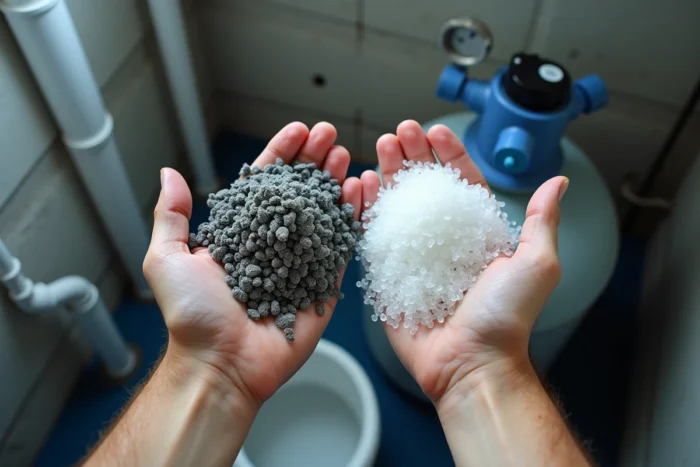
A family pool used seasonally, with low-limestone water, will retain its filter glass longer than a pool used daily by several swimmers. The hardness of the water plays a decisive role: very hard water causes faster agglomeration of the grains, even in recycled glass.
Returns vary on this point depending on the installations, but several factors accelerate wear:
- An insufficient backwash frequency, which allows organic residues to embed between the grains instead of being evacuated
- An overdose of flocculant, which clogs the filter bed by creating compact masses that are difficult to dislodge
- A pump flow rate poorly calibrated to the volume of the tank, which prevents proper mixing of the media during backwash
Monitoring these parameters allows for extending the lifespan of the glass and postponing replacement to its natural end.
Replacement of filtration glass: operational steps
Before touching the filter, turn off the pump and disconnect the power supply. Opening a pressurized tank can cause a violent backflow of water. Start by draining the residual water through the drain plug located at the bottom of the filter.
Extraction of the old media and inspection of the strainers
The extraction is done by hand or with a small construction vacuum. Protect the central tube (the distribution pipe) to avoid breaking it during handling. Once the tank is empty, inspect each strainer at the bottom of the filter.
A cracked strainer allows glass to pass directly into the return circuit, which sometimes explains the presence of small grains in the pool. If only one strainer is damaged, replace it before reloading. Take advantage of the open tank to clean the internal walls with a jet of water, removing limescale deposits and greasy residues.
Filling and first rinse of the pool filter
Fill the tank with water to halfway before pouring in the filter glass. This water protects the strainers from the shock of the grains and prevents them from dislodging under the weight of the media.
Pour the glass gradually, respecting the volume indicated by the filter manufacturer (and not the media). Excessive filling reduces the mixing space and decreases the effectiveness of the backwash. Slightly compact each layer by hand, without compressing.
Once the filter is closed, start a rinse cycle (position “rinse” on the multiport valve) for a few minutes before switching back to filtration mode. This step removes fine glass dust and prevents it from being sent into the pool. Check the pressure on the gauge: note this reference value, as it will serve as a benchmark for the following months.
Recycled glass or technical filtration glass: which media to choose for the tank
Not all filtration glasses are created equal. Crushed recycled glass, often cheaper, offers adequate filtration quality for a standard residential pool. Its smooth surface limits bacterial adhesion compared to silica sand, which reduces biofilm formation in the tank.
The so-called “technical” or “activated” filtration glass undergoes an additional surface treatment that gives it an electrostatic charge. This property attracts ultrafine particles and improves filtration finesse. For a pool exposed to high organic pollution (nearby trees, intensive use), this type of media represents a relevant choice despite a higher cost.
In both cases, the filtration glass replaces sand in the same filter without modification of the equipment. Generally, a smaller weight of glass is used compared to sand for the same tank volume, as the density of glass is lower. Check your filter’s technical sheet for the exact dosage.
Switching to glass from a traditional sand filter does not require any change of pump or piping. Only the media changes; the tank and multiport valve remain the same. It is an operation accessible to any pool owner equipped with a minimum of tools, provided that the steps for draining, inspection, and rinsing described above are followed.