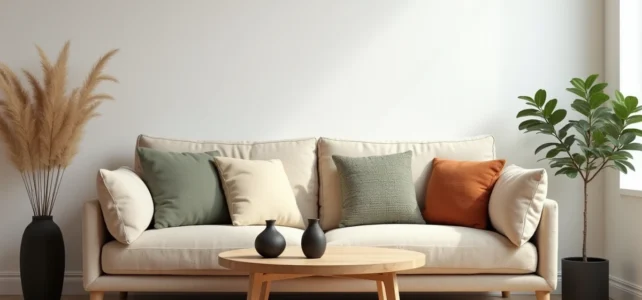
Smooth white walls are losing ground in French interiors. Paint catalogs, mainstream brands, and professional decorators are converging towards palettes and materials that break away from the monochrome minimalism that has dominated for a decade. Here are the decor trends that will concretely change a living room or bedroom in 2026, beyond moodboards.
Textured Neutrals vs. Pure White: What Decor Pros Favor in 2026
Warm neutrals paired with textured finishes are gaining traction in interior design projects. Sandy beige, greige, soft terracotta, sage green: these shades are replacing smooth white in both small apartments and large living spaces.
The difference lies not only in color. Finishes play a crucial role: lime-effect paints, soft microcement, wooden slat panels provide a visual depth that matte white does not produce. The wall becomes a decorative element in itself, not just a backdrop.
To explore all the decoration on Deco Asaiss, textured neutrals are an accessible entry point: they require neither heavy renovation nor new furniture to radically change the atmosphere of a room.
| Wall Approach | Visual Effect | Maintenance | Suitable for Small Spaces |
|---|---|---|---|
| Pure Matte White | Bright, uniform | Visible marks | Yes (enlarges but flattens) |
| Textured Sandy Beige | Warm, deep | Less visible marks | Yes (enlarges and structures) |
| Sage/Olive Green | Soothing, enveloping | Easy touch-ups | Yes (with appropriate lighting) |
| Lime/Microcement Effect | Irregular, artisanal | Delicate cleaning | Yes (draws the eye, creates texture) |
Sage green and sandy beige work well in both a living room and a bedroom. However, the lime effect requires sufficient natural light to avoid a dull appearance in north-facing rooms.
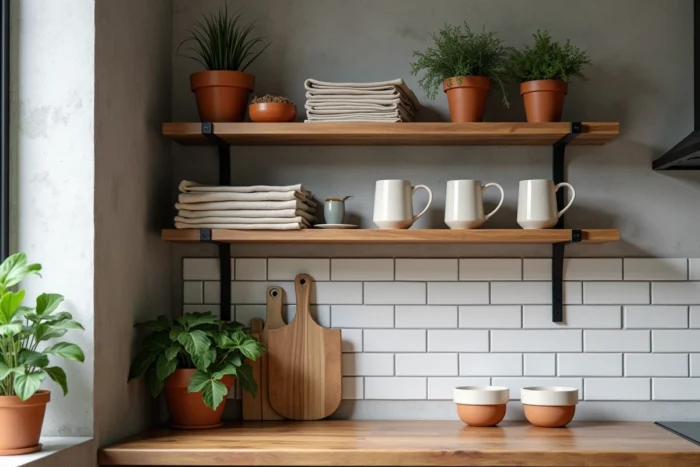
Pantone Colors 2026 and Their Concrete Application Room by Room
Pantone has named Cloud Dancer (PANTONE 11-4201) as the color of the year 2026, a creamy off-white that moves away from cold optical white. Meanwhile, WGSN and Coloro have identified Transformative Teal as a key shade, a deep blue-green already adopted by brands like Conforama in their furniture and accessory collections.
These two colors do not work the same way depending on the room:
- Cloud Dancer effectively replaces pure white on the walls of the living room and bedroom. It softens artificial light without darkening the space and pairs well with light wood as well as walnut.
- Transformative Teal works better as an accent than as a dominant color: cushion, accent chair, kitchen backsplash. When applied to an entire wall, it requires well-thought-out lighting to avoid visually shrinking the room.
- In the bathroom, the combination of the two shades (Cloud Dancer for the walls, Teal for textile accessories) creates a balanced contrast without saturation.
A common mistake is to apply a trendy color everywhere. A well-placed accent transforms more than an all-over look that will tire in a few months.
Biophilia in Apartments: Natural Materials and Integration of Plants
Biophilia goes far beyond just having a green plant on a shelf. In 2026, this approach structures complete design choices in urban apartments, motivated by well-being as much as by aesthetics.
Wood remains the pivotal material. But its use is evolving: vertical oak or pine wall slats create a texture and rhythm effect on an accent wall. Paired with grazing light, they add depth to a hallway or narrow living room.
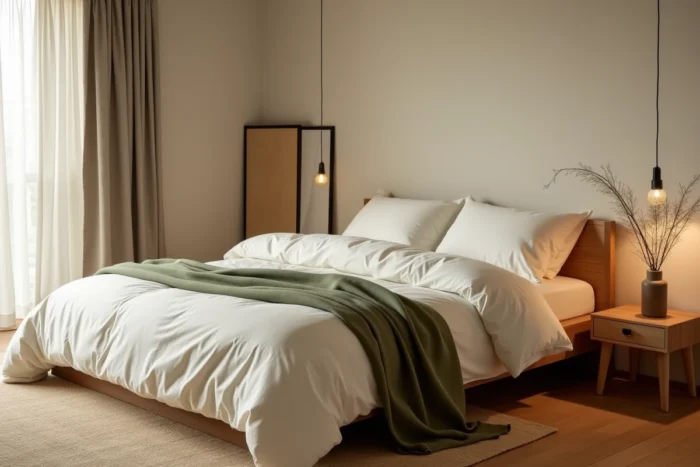
Rattan and caning are making a comeback in living room and bedroom furniture. Headboards, buffet doors, chair seats: these woven materials visually lighten the furniture without sacrificing sturdiness. They bring an artisanal dimension that standardized industrial furniture does not produce.
On the plant side, stabilized green walls (maintenance-free, no watering) are gaining ground in open kitchens and entryways. They absorb some ambient noise, a concrete advantage in open-plan apartments.
Slow Decor and Thrifted Pieces: How This Movement Changes Furniture Choices
The slow decor trend, confirmed by several specialized media for 2025-2026, is based on a simple principle: decorate less but with chosen and durable pieces. Fast, mass-produced furniture, replaced every season, is giving way to thrifted, restored, or artisanal furniture.
This movement has measurable consequences on interior layout. Online flea markets and second-hand platforms are expanding their offerings of vintage furniture. A 1960s buffet or a reclaimed solid wood table brings a patina and uniqueness that no new furniture can replicate.
Style no longer relies on the perfect coherence of a matched set. Mastered eclecticism, which mixes eras and materials, replaces catalog uniformity. A mid-century armchair can coexist with a contemporary lamp and a Berber rug without the whole seeming incoherent, provided a limited color palette is maintained (a maximum of three shades).
Slow decor also involves giving up filling every square meter. Allowing a space to breathe, accepting a bare wall or a partially empty storage surface is part of the approach. Emptiness becomes a decorative choice, not a lack.
The interior that ages best in 2026 is not the one that follows all the trends, but the one that retains one or two and applies them with sincere materials. A lime wall, a thrifted piece, a narrowed palette around textured neutrals: these few choices stand the test of time where a complete makeover goes out of style in two seasons.