
You may have moved your bed several times in the room without really noticing any change in your sleep. The orientation of the head of the bed – north, south, east, or west – is subject to very different recommendations depending on whether you listen to Feng Shui, Vastu Shastra, or sleep specialists. So, should you really prioritize a direction for better sleep?
What the Earth’s magnetic field changes (or not) for sleep
The Earth generates a magnetic field between its two poles. Some traditions deduce that our body, traversed by micro-currents of electricity, would react to this polarity during the night. The idea is appealing, but the available scientific studies have never managed to demonstrate a measurable effect of the geographical orientation of the bed on sleep quality.
In concrete terms, there is no solid evidence linking the north-south axis to better rest. The Earth’s magnetic field remains extremely weak compared to the fields produced by electronic devices present in most bedrooms. Researchers who have looked into the subject observe that the question of sleeping with the head to the north or south is more a matter of cultural belief than physiology.
This does not mean that the orientation of the bed is unimportant. It does matter, but for much more concrete reasons: exposure to morning light, drafts, proximity to a radiator or a window.
Feng Shui and Vastu Shastra: two traditions, two opposing directions
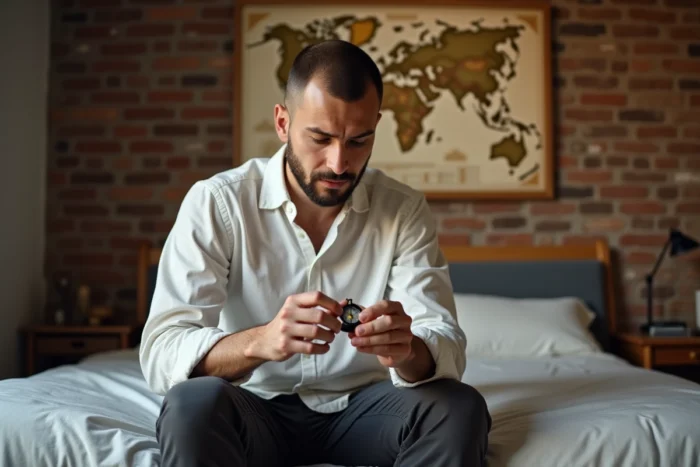
Feng Shui, a Chinese philosophy of space arrangement, does not provide a single answer. The ideal direction depends on each person’s Kua number, calculated from the year of birth and gender. Some Kua profiles orient the head to the north, others to the southeast or west. Feng Shui does not systematically recommend the north.
Vastu Shastra, an Indian architectural tradition, takes a firmer stance. It firmly advises against sleeping with the head to the north, as this position would align the body’s positive pole with that of the Earth, causing, according to this philosophy, poor energy circulation. The preferred direction according to Vastu Shastra is south or east.
Do you notice the paradox? Two ancient systems, both respected for centuries, reach different conclusions. This illustrates well that these recommendations are based on philosophical frameworks, not on physiological measurements.
The factors that really change sleep quality
Rather than turning your bed towards a specific cardinal point, focus on the parameters whose effects on sleep are documented. Here are the most determining:
- The light in the room: exposure to natural light in the morning helps to set your circadian rhythm. Orienting the head of the bed so that daylight gradually reaches your face upon waking can facilitate the transition to wakefulness.
- The room temperature: a room that is too hot disrupts falling asleep and causes nighttime awakenings. Relative coolness promotes the production of melatonin, the sleep hormone.
- Noise and sources of disturbance: a bed placed against a wall shared with the street or a noisy neighbor will degrade your sleep much more surely than a poor magnetic alignment.
- The quality of the bedding: a mattress suited to your body type and a pillow that keeps the neck in a neutral axis matter more than the direction of the head of the bed.
For people over 65, these factors carry even more weight. With age, melatonin production decreases and deep sleep reduces. Geriatricians recommend focusing on light and bedtime rhythm, not on the geographical orientation of the bed.
Bed position in the room: the concrete rules that help

Before choosing between north and south, first check that your bed is well positioned in relation to the elements in the room. A few practical guidelines are agreed upon by professionals in space planning and sleep specialists.
Place the head of the bed against a solid wall, without a window just above. A solid wall provides a sense of security that facilitates falling asleep. Avoid positioning the bed directly in front of the door: in many cultures (and according to Feng Shui), this configuration generates a feeling of exposure.
Access to the bed should remain clear on both sides. This facilitates movement in the room, reduces discomfort if you are sleeping two, and allows for better air circulation around the mattress.
Keep the head of the bed away from power strips, charging phones, and internet boxes. These devices emit electromagnetic fields much stronger than that of the Earth, and their immediate proximity to the head for several hours each night deserves attention.
North, south, east, or west: test rather than believe
If you have the space to reorient your bed, nothing prevents you from experimenting. Keep the same orientation for two to three weeks and note your feelings upon waking: ease of falling asleep, number of nighttime awakenings, sense of rest in the morning.
Then change direction and compare. Your own feelings over several weeks are worth more than a universal rule. Some people indeed sleep better with their head to the south, others to the north, without science being able to explain this individual preference other than by subjective comfort and the layout of the room.
The orientation of the bed remains a secondary parameter of sleep. The regularity of bedtime, limiting screens in the evening, and a cool, dark, and quiet environment form the foundation of restorative sleep, regardless of the cardinal point towards which your pillow points.