Decorating an interior with French handcrafted pieces raises a rarely asked question: how to distinguish a genuinely made object by a qualified artisan from a product simply assembled in France and presented as such? The answer lies in a precise regulatory framework, verifiable labels, and manufacturing criteria that separate authentic French craftsmanship from decorative marketing.
Artisan Quality and the Origine France Garantie Label: What the Regulations Impose
Since a decree in June 2023, the quality of artisan is granted by the chamber of trades to individuals who justify a diploma of CAP/BEP level in the relevant trade or three years of professional experience. This qualification legally conditions the use of the term on shops and websites selling interior creations presented as artisanal.
The registration of artisanal businesses now goes through the National Register of Enterprises (RNE) via the single window of the INPI, in place since January 1, 2023. This change replaces the former autonomous directory of trades.
The mention “Made in France” can be affixed on the simple declaration of the manufacturer, without systematic control. In contrast, the label Origine France Garantie requires an independent audit verifying that the product derives its main characteristics from manufacturing carried out in France. For a decorative object, the difference between these two mentions radically changes the level of guarantee offered to the buyer.
| Criterion | Made in France | Origine France Garantie |
|---|---|---|
| Control | Declarative (manufacturer) | Independent audit |
| Manufacturing verification | Non-systematic | Main characteristics manufactured in France |
| Cost for the artisan | None | Certification fees |
| Reliability for the buyer | Variable | High |
Workshops like those referenced on https://www.lateliersingulier.fr/ illustrate this approach to transparency regarding the origin and manufacturing process of the offered pieces.
Decorative Craftsmanship and Eco-responsibility: Materials and Short Circuit
The ethics of a handcrafted creation for the interior is not limited to the place of manufacture. It is also measured by the materials used and the length of the circuit between the workshop and the home.
Several criteria allow for evaluating the eco-responsible dimension of a handcrafted decorative object:
- The origin of raw materials: wood from sustainably managed forests, local clay for ceramics, textiles made from French natural fibers (linen, hemp)
- The surface treatment: some artisans exclude industrial varnishes in favor of finishes based on vegetable oils or natural waxes
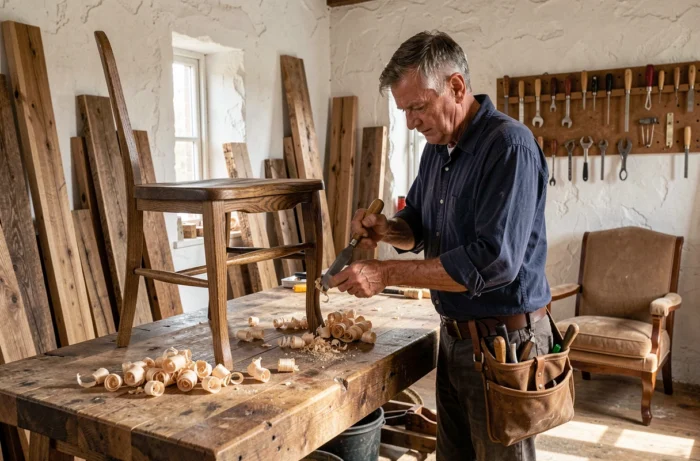
- The management of offcuts: in a carpentry or leather goods workshop, revalorizing offcuts into small objects (coasters, keychains) reduces waste rates
- The delivery distance: a creator selling through short circuits, via local markets or a direct online shop, limits logistical intermediaries
The “slow deco” trend, which favors durable pieces acquired gradually rather than frequent furniture renewal, directly relies on these parameters. A handcrafted object designed to last several decades generates a much lower environmental impact than a series of industrial replacements.
Ceramics, Wood, Textiles: Comparing French Artisan Sectors
Not all artisan sectors have the same production constraints or timelines. Comparing three dominant materials in artisanal interior decoration helps better calibrate expectations.
Artisanal Ceramics
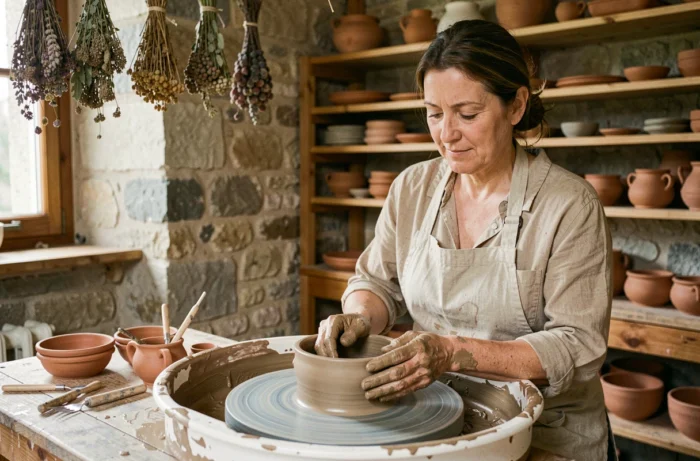
The production of a piece in stoneware or earthenware involves several firings, slow drying, and often manual glazing. Each ceramic piece is structurally unique, with variations in hue and texture related to firing. Production times are among the longest in decorative craftsmanship.
Woodworking
Local species (oak, walnut, ash) dominate among French cabinetmakers and wood turners. The natural drying of wood can take several months before shaping. The choice of species determines durability and appearance: a solid oak tabletop will not age like a pine object.
Textiles and Embroidery
French linen, primarily grown in the north of the country, feeds an artisanal textile sector that produces cushions, curtains, and tablecloths. Hand embroidery, still practiced by some workshops, remains the longest technique in terms of time per piece.
Selection Criteria for a Reliable Artisan Purchase
Buying a handcrafted creation for your interior without checking a few specific points exposes you to disappointments. The legal status of the artisan and the traceability of the product are the two priority filters.
- Check that the seller holds the artisan quality (registration in the RNE, diploma or verified experience)
- Prefer pieces bearing the Origine France Garantie label rather than a simple declarative “Made in France”
- Request information about the materials: origin, treatment, finish
- Consult the manufacturing conditions: individual workshop, small series, or partial subcontracting
Marketplaces dedicated to French creators (Fait2mains, Un Grand Marché) generally require their sellers to prove their artisan status. This layer of verification reduces the risk of buying a disguised industrial product.
A well-documented artisanal object justifies a higher price because it incorporates an unavoidable manufacturing time, traceable materials, and certified know-how. The 2023 decree on artisan quality now gives buyers a concrete lever to distinguish authentic creations from mere commercial claims.