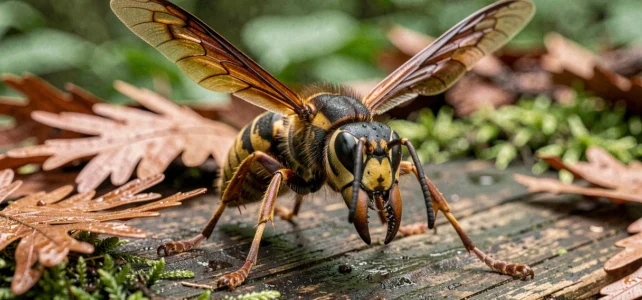
The venom of the Japanese giant hornet (Vespa mandarinia) is primarily associated with intense pain and an allergic risk. However, several recent studies in pharmacology are reversing this perspective: this complex mixture of peptides, enzymes, and secondary metabolites is now of interest to biomedical research for its antimicrobial, anticancer, and neuroprotective properties. What exactly do we measure in this venom, and how do these data compare to those of other venoms already used in medicine?
Molecular profile of giant hornet venom compared to other therapeutic venoms
Animal venoms used in pharmacology are not all equivalent. The active components vary by species, as do their potential applications. The table below summarizes the main families of molecules and the associated therapeutic avenues, based on data available in recent literature.
| Venom | Main components | Identified activities | Stage of exploitation |
|---|---|---|---|
| Japanese giant hornet (Vespa mandarinia) | Peptides (mastoparan type), enzymes (phospholipases), secondary metabolites | Antimicrobial, anticancer, antioxidant, anesthetic, neuroprotective | Preclinical research (animal models, molecular profiling) |
| Snakes (e.g., Bothrops jararaca) | Peptides inhibiting the enzyme converting enzyme | Antihypertensive | Marketed drug (captopril) |
| Bee (Apis mellifera) | Melittin, apamine | Anti-inflammatory, immunomodulatory | Clinical trials and apitherapy |
| Scorpion (Leiurus quinquestriatus) | Chlorotoxin | Tumor marker (gliomas) | Clinical trials (surgical imaging) |
The venom of the giant hornet stands out due to its diversity of simultaneous therapeutic avenues, whereas most venoms used in medicine target a single indication. This versatility is due to the richness of its molecular composition, highlighted by recently published integrated venomics profiling approaches.
To learn everything about the giant hornet sting and its biological mechanisms, understanding this composition is a necessary prerequisite.
Mastoparan-type peptides: neuroprotective activity in animal models
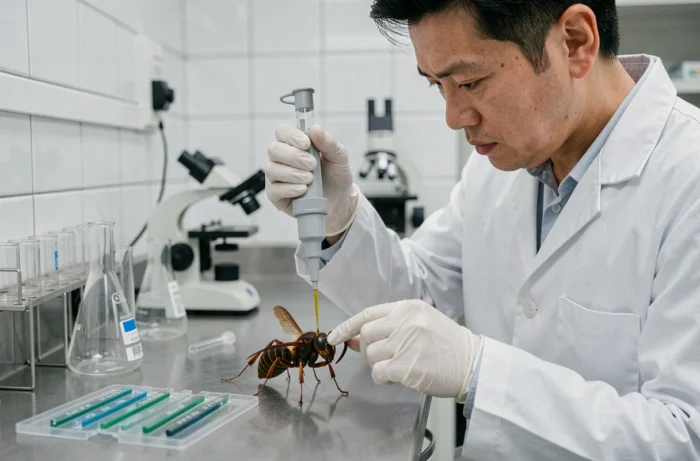
Among the molecules in hornet venom, mastoparan-like peptides attract significant scientific attention. These short peptides, capable of crossing cell membranes, have shown neuroprotective effects in animal models of cerebral ischemia-reperfusion.
Ischemia-reperfusion reproduces the damage caused by a stroke: interruption of blood flow, followed by injury when circulation resumes. In these models, the administration of mastoparan-type peptides reduced markers of neuronal distress.
This avenue is particularly pursued as current neuroprotective treatments remain limited. However, transitioning from animal models to human application involves lengthy and costly validation steps. No clinical trial on humans has been published to date for these peptides derived from the giant hornet.
What separates mastoparan from a drug
An active peptide in the laboratory is not a drug candidate. Several obstacles remain to be overcome:
- The stability of the peptide in the human body: short peptides are often rapidly degraded by digestive and plasma enzymes, limiting their bioavailability.
- Action selectivity: mastoparan interacts with several types of cell membranes, which can cause side effects (hemolysis, inflammatory reaction) at therapeutic doses.
- The mode of administration: an intravenous or intracerebral injection in animal models does not directly translate to outpatient treatment in humans.
These constraints explain why research is also focusing on modified synthetic analogues, designed to retain biological activity while improving tolerance.
Structural similarities with molecules already used in oncology
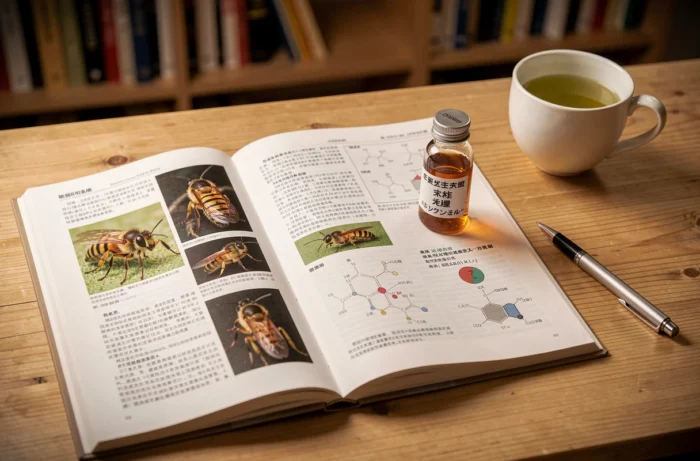
A less discussed aspect concerns the structural similarities between certain components of Vespa venom and existing or developing drugs. Recent molecular profiling studies have identified analogies with vorinostat and bardoxolone, two molecules used respectively against certain lymphomas and in anti-inflammatory trials.
Vorinostat is a histone deacetylase inhibitor, approved for the treatment of cutaneous T-cell lymphoma. Bardoxolone methyl targets the Nrf2 pathway, involved in the response to oxidative stress and chronic inflammation. Finding similar patterns in the venom of the giant hornet paves the way for what pharmacologists call rational repositioning: starting from a natural structure to design new therapeutic molecules.
This type of approach has already been successful. Captopril, the first angiotensin-converting enzyme inhibitor used against hypertension, directly derives from a peptide isolated from the venom of a Brazilian snake. The venom of the giant hornet follows a comparable trajectory, but at a much earlier stage.
Japanese giant hornet venom and immunology: an emerging avenue
Beyond molecular pharmacology, the venom of Vespa mandarinia is also of interest to immunology. Studies presented at specialized conferences explore how certain components of the venom modulate the immune response, particularly the production of specific immunoglobulin E (IgE).
This research stems from a clinical observation: patients stung by giant hornets sometimes present atypical immune profiles, with cross-reactivities between different species of wasps and hornets. Understanding these mechanisms could improve allergy desensitization protocols, a field where current treatments still rely on poorly standardized venom extracts.
The stakes are not only therapeutic but also diagnostic: identifying the major allergenic components of giant hornet venom could lead to the development of more precise tests for exposed patients, especially in regions where this species is endemic.
Pharmacological bioresource: where is research on hornet venom
The venom of the Japanese giant hornet has not yet produced a drug. The gap between a promising molecular profile and market authorization remains considerable. Current data place this bioresource at the preclinical profiling stage, with encouraging results on several simultaneous fronts.
What distinguishes this venom in the research landscape is the convergence of multiple therapeutic avenues from a single biological source. Antimicrobial, anticancer, neuroprotective, immunomodulatory: few animal venoms cover such a wide spectrum from the initial characterization studies. The future will depend on the ability of research teams to isolate the most promising peptides and produce stable analogues tolerated by the human body.