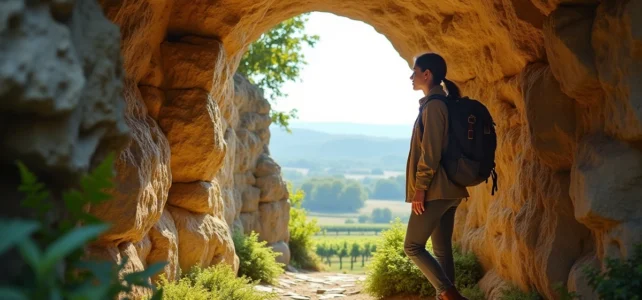
Sleeping in a treehouse above a pond in Sologne is one thing. Finding the place, ensuring it’s not just an overrated glamping site, organizing the trip without a car: that’s where the journey truly begins. In France, unusual getaway options are multiplying, but not all of them are equal. You still need to know where to look and how to filter.
Concrete financial advantages of low-carbon travel in France
Responsible travel is often associated with extra costs. The reality on the ground tells a different story. Since May 2026, the city of Lorient has been testing the “Ker Lorient” pass: discounts at around forty establishments for visitors who arrive using soft mobility (train, bike, walking, public transport) and stay a minimum number of nights on-site.
The principle is simple: if you prove that you arrived without a car, you gain access to reduced rates at hotels, restaurants, museums, and partner activities. This type of local initiative changes the game because it transforms a perceived constraint (not taking the car) into a cost-saving lever.
On the accommodation side, the 2026 sustainable tourism fund supported by ADEME subsidizes the ecological transition of small businesses and tourist SMEs in rural or peri-urban areas, covering between 40% and 80% of investments. For travelers, this means that unusual accommodations in rural areas are improving in quality without prices skyrocketing.
With energy renovations partly funded by public funds, prices remain reasonable. You can gather getaway ideas and filter by type of accommodation or region on vagabondes.fr, which saves you from spending three hours sifting through scattered listings.
Unusual accommodations in France: sorting real escape from marketing
Yurt, tiny house, transparent bubble, treehouse, caravan: the term “unusual” has become a selling point. To avoid ending up in a prefab structure placed by a main road, a few sorting criteria are essential.
- The exact location matters more than the type of structure. A yurt on the edge of a state forest with no neighbors within a kilometer offers a radically different experience from a yurt in an “unusual village” where ten units are lined up
- Environmental labels (Green Key, European Ecolabel) do not guarantee the unusual nature, but they filter operators who make a minimum effort in managing water, energy, and waste
- Feedback varies on this point, but requesting recent photos from the owner remains the best reflex. Professional photos may date back to the opening, and the actual condition can be surprising
- Check access: some isolated accommodations require an all-terrain vehicle or a thirty-minute walk with luggage. If you are traveling by train, this is a parameter to settle before booking
The case of heritage conversions
There are now lighthouses, locks, and former train stations transformed into guesthouses. These conversions often offer a unique architectural setting that new constructions cannot replicate. The point of caution: thermal comfort. A granite lighthouse in Brittany heats slowly and cools quickly, which can turn an off-season stay into a trial if the insulation has not been updated.
Slow travel by train: organizing a getaway without a car
The slow travel concept is based on an operational principle: slow down travel to increase the time spent on-site. In France, the rail network allows for combining this approach with a controlled budget, provided you plan correctly.
The first reflex is to check the TER service to the desired destination. Small regional lines serve areas that the TGV ignores, often at very low rates. The challenge lies in the frequency: on some rural lines, only two or three trains run per day. Aligning your stay with TER schedules rather than the other way around avoids unpleasant surprises.
For the last few kilometers, several options exist depending on the area: demand-responsive buses, folding bikes taken on the train, local carpooling. Lorient’s initiative with its soft mobility pass shows that some communities are beginning to structure the welcome for travelers without cars.
Day micro-adventure or multi-night stay
You don’t have to leave for a week to travel differently. A night in a floating cabin less than two hours by train from home can be enough to create a break from the daily routine. The idea of a micro-adventure works particularly well in France because the diversity of landscapes allows for a true change of scenery at a short distance.
The classic trap: wanting to fit everything in. Planning just one activity per day (a hike, a visit to a producer, a kayaking session) leaves room for the unexpected, which is often what you remember most from a trip.
Thematic itineraries for targeted unusual getaways
Instead of choosing a destination and then looking for things to do there, you can reverse the logic: start from a theme and let the territory impose itself.
- Volcanism and geology: the chain of Puys in Auvergne offers hikes on dormant volcanoes, with characterful guesthouses in the surrounding villages
- River heritage: navigate the Canal du Midi or the Canal de Bourgogne by renting a habitable barge, with no license required for rental boats
- Vineyards and local produce: staying with a winemaker in Jura or Alsace allows you to combine unusual accommodation with discovering a craft, away from standardized tourist circuits
These thematic itineraries work because they provide a thread for the stay. You don’t visit “a region,” you explore a subject through a territory. The difference is felt in the quality of encounters and the coherence of the experience.
Unusual travel in France does not require a huge budget or complex organization. It mainly requires asking the right questions before booking: what access without a car, what real comfort on-site, what thread for the stay. The rest follows.