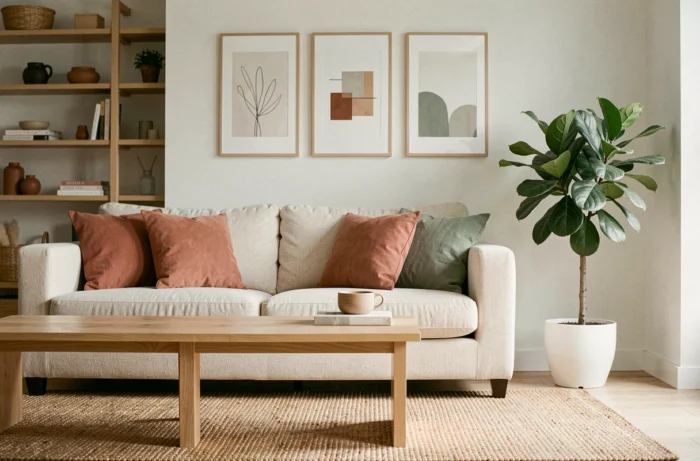
A sofa that’s too big for the living room, clashing colors between the open kitchen and the dining area, a light fixture bought on a whim that doesn’t match anything: we’ve all experienced that moment when interior decoration seems to resist our desires. Successfully arranging your home doesn’t depend on a huge budget, but on a few concrete decisions regarding materials, proportions, and light.
Natural textiles and PFAS regulations: a decor choice that anticipates
When choosing a fabric for a sofa or curtains, the issue of stain treatment arises quickly. Fabrics treated with PFAS (per- and polyfluoroalkyl substances) are under scrutiny from European regulations. Instead of opting for a treated synthetic covering, favoring thick linen, wool, or dense cotton addresses the issue upfront.
Untreated linen ages beautifully over time without losing its shape. Dense cotton withstands regular washes at high temperatures. These textiles fit well in a living room with neutral tones as well as in a bedroom with bolder colors.
This logic is echoed in the decor tips from Tip Top Déco et Maison, which remind us that the coherence of materials between rooms creates a natural thread throughout the home.

Sustainable furniture and ESPR regulation: decorating with repairability in mind
The European ESPR regulation (Ecodesign for Sustainable Products Regulation) is gradually expanding its requirements to furniture. Specifically, this means that demountable and repairable furniture will be favored over glued or non-dismantlable assemblies.
For interior decoration, this is not just an administrative constraint. It is a criterion for choice at the time of purchase.
- A solid wood sideboard assembled with mortise and tenon joints can be repaired, sanded, and repainted. It withstands trends and moves.
- A modular shelf with a metal frame allows for the replacement of a damaged shelf without changing the entire unit. The configuration can be adapted according to the available space.
- A table with a screwed (not glued) top allows for partial replacement. If the top is scratched, it can be replaced without discarding the structure.
Choosing repairable furniture means investing once in a piece that lasts, rather than buying a disposable item every three years that ends up in the landfill.
Reuse, an underutilized potential
There is much talk about thrifting, second-hand items, and antique furniture integrated into modern decor. The reality of the sector remains more modest: according to Ecomaison, only 5% of household objects and materials processed in 2025 were directed towards reuse. The gap between the desire for responsible decorating and actual practice remains wide.
This doesn’t mean we should give up. A thrifted piece brings a personality that new furniture struggles to replicate. Opinions vary on this point, but an antique dresser in a contemporary bedroom often creates a more interesting contrast than a coordinated set from the same catalog.
Colors and natural light: adapting the palette to the actual room
The rule of color proportions (dominant, secondary, accent) circulates everywhere. It can be found among all competitors. What is often lacking is the adaptation of this palette to the actual exposure of each room.
A north-facing living room receives cold, indirect light for most of the day. Applying a pure white on all walls creates a clinical effect, not a warm one. An off-white leaning towards yellow or a sandy beige corrects this coldness without darkening the space.
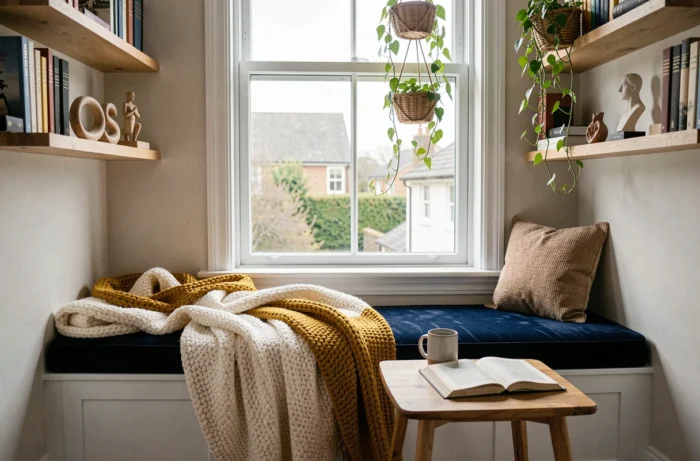
Conversely, a south-facing open kitchen can handle more saturated colors because direct light “washes” them for part of the day. A sage green or terracotta that would appear dark in a north-facing exposure gains depth with generous sunlight.
Test before painting an entire wall
The difference between a paper color swatch and the actual result on a wall is often underestimated. Applying a paint sample (at least 50 cm by 50 cm) directly on the concerned wall, then observing it morning, noon, and night, avoids unpleasant surprises. The color changes radically depending on the time of day and orientation.
This test takes half a day and costs the price of a sample pot. It prevents the need to repaint an entire living room two weeks later.
Furniture proportions in the living room: circulation before aesthetics
A large corner sofa in a modestly sized living room blocks circulation and visually overwhelms the space. Before choosing a decor style, measure the pathways.
- A comfortable passage between two pieces of furniture requires at least 60 cm of free space. Below that, you bump into things, navigate around, and eventually stop using the area.
- The coffee table should not occupy more than half the length of the sofa. Beyond that, it creates a visual and physical obstacle.
- In a long room, placing the sofa perpendicular to the longest wall breaks the corridor effect and creates two distinct zones (living area, dining area).
Measuring the space before buying any furniture remains the most cost-effective rule in interior decoration. A quick floor plan, even sketched out with actual dimensions, prevents most layout errors.
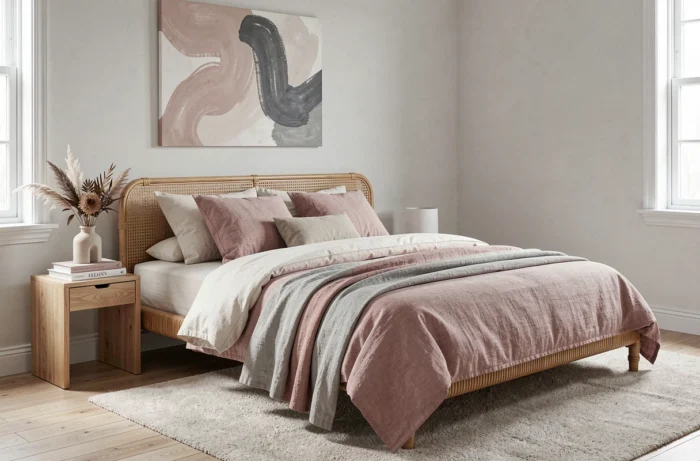
The decoration of a harmonious home does not rely on an accumulation of trends. It depends on choices of durable materials, a color palette tested in real light conditions, and furniture proportionate to the available space. These are simple decisions, but they transform a cluttered interior into a place where one feels at home.