
A cat that doesn’t return at the usual time doesn’t always mean it’s missing. Felines explore, hunt, get accidentally locked in a neighbor’s garage, or follow a scent trail farther than expected. The challenge for the owner is knowing when to shift from passive waiting to active searching, and especially which actions yield concrete results.
Behavior of the missing cat: understanding before searching
Before launching a widespread search, you need to think like a cat. A feline that has fled after a stress event (fireworks, dog, fall) adopts a specific reflex: it hides very close to the place it fled from. Under a gallery, a staircase, a parked vehicle, or in a dense plant mass. In the first hours, it remains still and silent, even if you call it.
An unneutered cat can cover much greater distances, attracted by the pheromones of a female in heat. An older cat may lose its olfactory and visual landmarks, making independent return more difficult. The cat’s natural curiosity also drives it to visit a garden shed, a basement, or an open truck, where it may accidentally get locked in.
These scenarios explain why the majority of cats found are located very close to their home. To understand what to do if my cat doesn’t come back according to La Maison des Animaux, you must first grasp this territorial logic before putting up posters miles away from home.
I-CAD declaration and online reporting: the right timing
Reporting a loss to the I-CAD file (Identification of Domestic Carnivores) remains the most effective administrative step in France. Recent recommendations emphasize a often overlooked point: report the disappearance within 24 hours and simultaneously check that your contact information (phone, address, email) is up to date in the file.
This verification is not trivial. A cat found and scanned by a veterinarian or shelter will be identified by its microchip or tattoo, but the contact will only succeed if your information is correct. The declaration can be made online on the I-CAD website, by email, or by phone.
The Filalapat app as a neighborhood relay
Launched by I-CAD, the Filalapat app allows for the free dissemination of a geolocated alert. It reaches an audience different from Facebook groups dedicated to lost animals, which broadens the search area without extra effort.
Newer tools like Animou operate in three stages: quick reporting with photo and location, automatic dissemination to neighborhood residents, and then secure connection between the owner and those who have seen the animal. Some municipalities and associations now use this type of platform as a systematic relay, increasing local coverage.
Ground search for the lost cat: method and timing
Physical searches remain the most direct lever. The recommended method is based on a few principles related to feline behavior.
- Start with a very restricted perimeter around the home: under vehicles, in hedges, under terraces, in any accessible enclosed space (garage, shed, dumpster area). A stressed cat will not respond to its name.
- Conduct rounds during quiet hours, early in the morning or late in the evening, when ambient noise decreases. The cat is more likely to come out of its hiding place in silence.
- Bring strong-smelling food (tuna, wet food): the cat’s sense of smell picks up these signals from several dozen meters away, which may coax it out even if it’s frozen in fear.
- Place a worn piece of clothing and uncleaned litter outside your door. These familiar scents serve as an olfactory beacon for a disoriented cat.
Consistency matters more than duration. Several short rounds over several days yield better results than a single intensive search.
Alerting the neighborhood in a targeted way
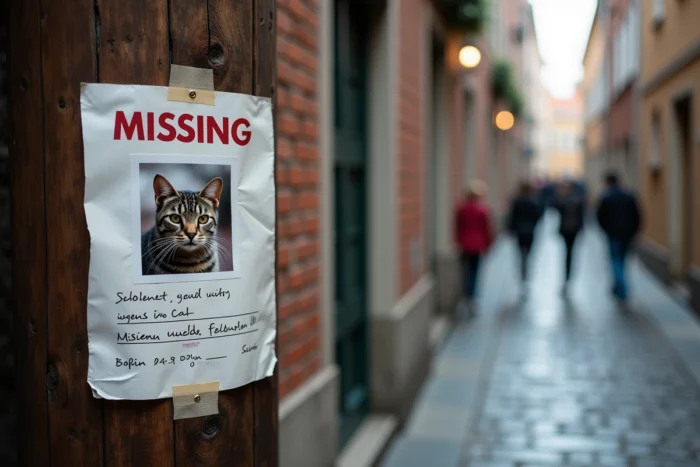
Paper posters within a few hundred meters remain useful, provided they include a clear photo, a precise description (color, distinguishing features, collar) and a direct phone number. Asking neighbors to check their closed dependencies (basement, garage, garden shed) is a simple action that regularly leads to reunions.

Scams involving lost animals: signals to watch for
The distress of owners attracts scammers, mainly on social media and classified ad sites. The classic scheme: a person claims to have found your cat and asks for a sum to “repatriate” it or cover “veterinary expenses”.
Never send money before seeing your animal or receiving verifiable photo proof (recent photo with an element you request, like a current newspaper). False reports are common, especially when a disappearance ad circulates widely.
Secure platforms like Filalapat or Animou limit this risk by anonymizing exchanges until confirmation. In contrast, public Facebook groups offer no filter, which necessitates increased vigilance.
How long can a cat be absent before returning
Field returns vary on this point. Some cats reappear after a few hours, others after several weeks. A cat accidentally locked in will return as soon as it’s freed. A cat disoriented by a move or car ride will take longer to regain its bearings.
The persistence of searches remains the determining factor. Shelters and pounds keep found animals for a legal period before any adoption procedures, allowing a window to reclaim them. Regularly contacting shelters, veterinarians, and pounds in the area (including those in neighboring municipalities) increases the chances of reunions even after several days of absence.
A cat identified by microchip, reported lost to I-CAD, and listed on local platforms benefits from a detection network that an unidentified animal does not have. Identification remains the most effective preventive measure, far ahead of GPS collars or connected trackers, whose autonomy and range are limited for daily feline use.