
The reading fluency in CE1 is based on three measurable components: decoding accuracy, reading speed, and prosody. Working on these three areas with dedicated worksheets allows the student’s attentional resources to be freed up for comprehension. It is essential that the materials used follow a coherent progression and target the graphemic difficulties specific to this level.
Language criteria for an effective CE1 fluency worksheet
A fluency worksheet is not just a short text with a timer. The selection of graphemes and the length of words directly condition progress. In CE1, students consolidate the decoding of complex graphemes (oi, ou, an, on, ein, ain) and tackle irregular grapho-phonological correspondences (ey, ay, silent internal letters).
A well-constructed worksheet for period 1 prioritizes words with regular syllabic structure (CV-CV, CVC) with graphemes already automated in CP. Progression to polysyllabic words and consonant clusters (br, tr, fl, cr) begins in period 2. We recommend systematically checking that the proposed text does not contain graphemes not yet taught, lest the fluency exercise turn into a guessing game.
Teachers looking for CE1 fluency worksheets to download for free save preparation time, provided they sort resources according to this graphemic progression logic.
The vocabulary of the text also matters. A decodable word but unknown orally does not allow for prosody practice. The fluency text must contain at least three-quarters of words belonging to the student’s everyday oral vocabulary.

Calibrating the fluency text: length, syntactic complexity, and prosody
The length of the text varies according to the period and the student’s level. For an average reader in CE1, we observe that a fluency text should not exceed about a hundred words at the beginning of the year. By the end of CE1, longer texts allow for reading endurance practice.
Syntax and grouping for breath
The syntactic structure directly influences prosody. Short sentences (subject-verb-complement) at the beginning of the worksheet, followed by sentences containing a relative or circumstantial clause, allow for a gradual increase in prosodic difficulty within the same material.
The visual marking of breath groups on the worksheet accelerates progress. We use slashes (/) to segment sentences into units of meaning. This segmentation guides the student towards reading in groups of words rather than word by word, which remains the main barrier to fluency in CE1.
Narrative texts work better than documentary texts for fluency at this level. Dialogue, in particular, encourages the student to modulate their intonation and respect expressive punctuation (exclamation point, question mark).
Organization of the fluency quarter-hour in differentiated workshops
The fluency quarter-hour system, supported by academic trainers, relies on short and frequent sessions. Regularity takes precedence over duration. Four sessions of fifteen minutes per week yield more progress than one long weekly session.
Three levels of worksheets for the same text
A workshop approach requires having worksheets at multiple levels of difficulty. Here is an organization that works in practice:
- Level 1: the text is segmented into syllables with a color code, and the sight words are pre-identified. This level is suitable for students still in the phase of slow decoding.
- Level 2: the text is presented with breath group markings (slashes) but without syllabic help. This is the target level for the majority of CE1 students in the middle of the year.
- Level 3: the text is presented without visual aids. The student works on speed and prosody independently, aiming for a target of correctly read words per minute.
Each student progresses to the next level when they achieve a precise and fluent reading of the current level text, not before. The criterion for advancement is not speed alone, but the absence of errors combined with natural phrasing.
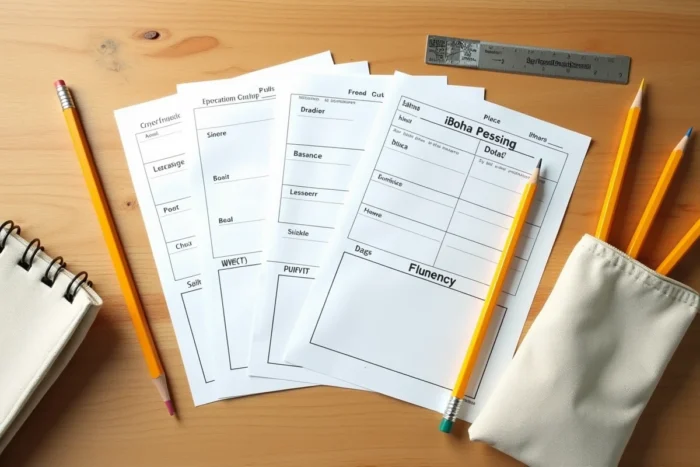
Tracking grid and measuring progress in CE1 reading fluency
Without a tracking tool, fluency work loses its main lever: the visibility of progress by the student themselves. The tracking grid accompanies each worksheet and serves two distinct functions.
The first function is diagnostic. The teacher notes the number of words correctly read in one minute (MCLM), the number of errors, and the type of errors (substitutions, omissions, additions). The type of error guides remediation much more than the raw score. A student who systematically substitutes similar graphemes (an/on, é/è) needs targeted work on visual discrimination, not just additional rereading.
The second function is motivational. The student records their score on a personal graph, making progress visible and tangible. This immediate feedback is a documented lever in cognitive science for maintaining engagement in a repetitive task.
Elements to include in the tracking grid
- Date and number of the worksheet to track the chronology of progress
- MCLM score with distinction between first reading and final reading (after practice)
- Record of recurring errors, categorized (decoding, vocabulary, prosody)
- Qualitative indicator of prosody: monotone reading, reading with pauses at commas, expressive reading
The comparison between the first reading and the final reading of the same text provides a direct measure of the training effect. The gap between these two scores is often more informative than the absolute score, as it reveals the student’s ability to progress with practice.
Reading fluency in CE1 is developed with calibrated materials, rigorous graphemic progression, and individualized tracking. The free worksheets available in PDF cover these needs, provided they are sorted according to the level of complexity and the time of year. The time spent sorting resources in advance is largely recovered in workshop efficiency.