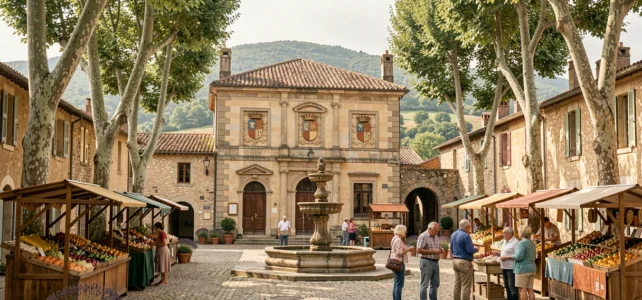
The Val Briard community of communes brings together 21 municipalities since the merger in 2017, resulting from the consolidation of the intercommunalities of Val Bréon, Sources de l’Yerres, and the municipalities of Courtomer and Favières. This area, located in Seine-et-Marne at the gates of Brie, concentrates land, logistical, and heritage issues that deserve a technical reading rather than a tourist overview.
Val Bréon ZAC: SDRIF constraints and the conditional RER station
The Val Bréon logistics park, located in the municipality of Chapelles-Bourbon, remains the economic engine of the territory. Its extension, known as Val Bréon II, led by Aménagement 77 and Grand Paris Aménagement, is part of a strategic opportunity study aimed at reconciling economic land use and land efficiency.
The point of friction is regulatory. The lands in question, acquired by the community of communes for over 17 million euros, are marked with yellow dots in the SDRIF 2030. Their urbanization is conditioned on the construction of an RER E station on the site. However, this station does not appear in the confirmed programs of Île-de-France Mobilités or SNCF. Urbanization remains legally suspended pending a non-scheduled transport infrastructure.
The extension study anticipates that more than half of the operational areas will be preserved for agricultural purposes, with the exploration of a structuring agricultural project in addition to the dominant cereal activity. Here we observe a mixed development model where logistics coexists with soil preservation, in line with the ambitions of SDRIF-E.
The site of Valbreon allows tracking administrative developments and ongoing projects in this changing area.
Intercommunal Merger Val Briard: what the redistricting has changed
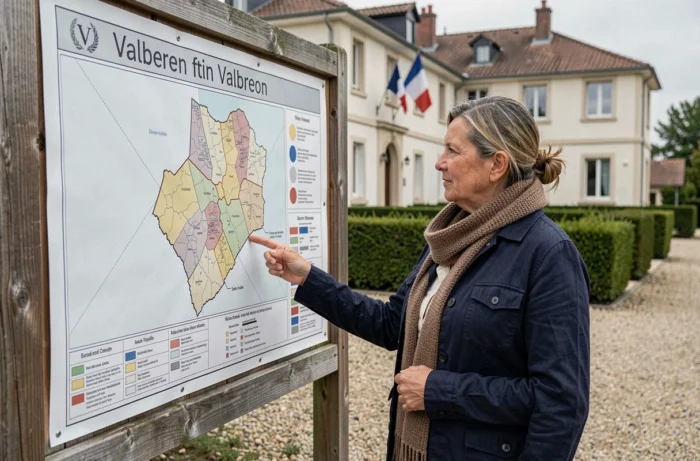
The Val Bréon community of communes, created in 1995 with its headquarters in La Houssaye-en-Brie, originally included 10 municipalities. The 2017 merger integrated it into a larger set of 21 municipalities and approximately 30,000 inhabitants. This redistricting redistributed intercommunal competencies and altered internal political balances.
Fontenay-Trésigny and Rozay-en-Brie are the two urban centers of Val Briard, with approximately 5,500 and 2,800 inhabitants, respectively. These two municipalities concentrate most of the essential structural facilities (swimming pool, gymnasiums, colleges, high school, cultural hall). The other municipalities retain a village morphology with an old center and residential areas.
The merger created new obligations in terms of planning. The development of a PLUi-H (intercommunal local urban planning document equivalent to a local housing program) is a significant technical undertaking for an intercommunality of this size, which must harmonize very heterogeneous urban planning documents from one municipality to another.
Biodiversity and water management in the logistics park
The territorial study conducted by BN Architectures for the Val Bréon extension establishes a precise environmental framework. The project aims to enrich a currently limited biodiversity on the logistics site by reintroducing planted areas with local and diverse species connected to the surrounding ecological corridors.
The management of wastewater and rainwater is designed at the surface level, with a threefold objective:
- Create functional landscapes that limit soil sealing and contribute to the visual integration of the site
- Combat the heat island effect, an increasing issue on the large concrete logistics platforms in Seine-et-Marne
- Reduce potable water consumption by utilizing rainwater on-site
The extension must also protect the village of Chapelles-Bourbon from visual and noise disturbances related to logistics traffic, by creating landscaped buffer zones and planning gentle traffic flows separate from heavy truck traffic.
Cultural candidacy and rural heritage of Val Briard
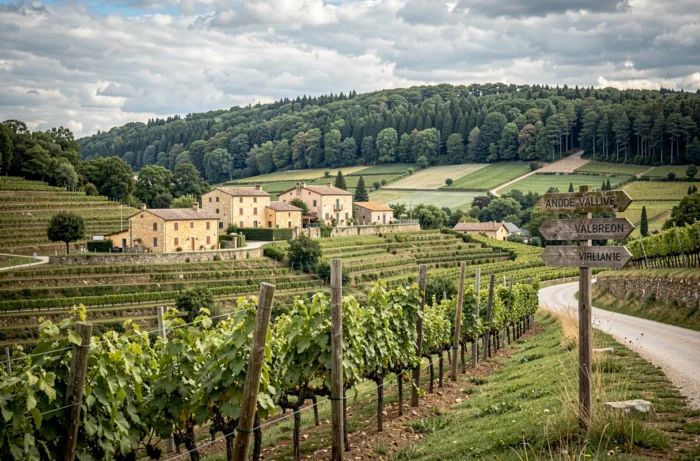
The Val Briard’s candidacy for the title of French capital of culture in 2021 produced structural effects beyond the outcome. This work helped unite the 21 municipalities around a shared inventory of rural heritage sites and local cultural facilities.
In concrete terms, the approach led to:
- An itinerant cultural program among the municipalities, circumventing the issue of the absence of a dedicated central venue
- The promotion of Briard agricultural memory, supported by the network of local producers and heritage farms like the Jean-Jacques Barbaux Farm
- The development of discovery routes of the Briard landscape, linking built heritage and natural spaces
This cultural network partially compensates for the structural deficit of tourist attractiveness of a rural area located between major hubs (Paris, Disneyland Paris, Villages Nature, Lumigny Safari Reserve) that capture most of the traffic.
The Briard terroir, with its local producers and large-scale agricultural landscapes, remains the main lever for differentiation. The networking of municipalities and associative actors resulting from the cultural candidacy has strengthened this identity without freezing it in a rigid heritage narrative. For a territory of this size, the ability to coordinate dispersed municipal initiatives across more than twenty villages determines the credibility of any medium-term attractiveness strategy.