How can we measure the cultural vitality of a region through its online media? Brittany has an ecosystem of news sites, heritage portals, and event platforms whose coverage varies by departments and themes. Comparing these sources allows us to identify where Breton information is most dense and where there are blind spots.
Coverage of Breton news by department: mapping the gaps
The four Breton departments (Finistère, Morbihan, Côtes-d’Armor, Ille-et-Vilaine) do not benefit from the same density of online cultural information. Regional media concentrate their editorial production on the most populated areas, creating a measurable imbalance in search results.
| Department | Dominant online themes | Main source types | Undercovered angle |
|---|---|---|---|
| Finistère | Festivals (Cornouaille, Brodeuses), religious heritage, coastal weather | Daily press, festival websites | Craftsmanship and contemporary arts professions |
| Morbihan | Megaliths, sailing, summer tourism | Tourist offices, heritage portals | Cultural associative life off-season |
| Côtes-d’Armor | Marine environment, agriculture, news items | Regional daily press | Oral traditions and collection |
| Ille-et-Vilaine | Rennes metropolis, economy, higher education | National press coverage, urban blogs | Rural vernacular heritage |
Finistère captures a significant share of cultural coverage thanks to the concentration of identity festivals. In contrast, Côtes-d’Armor remains underrepresented in terms of traditions and intangible heritage, despite an active associative fabric in collecting songs and stories.
To follow these topics throughout the year without relying on a single press title, it is possible to access Terre de Breizh online, a platform that aggregates content related to traditions, culture, and events in the region.
Breton cultural festivals in 2026: calendar and positioning
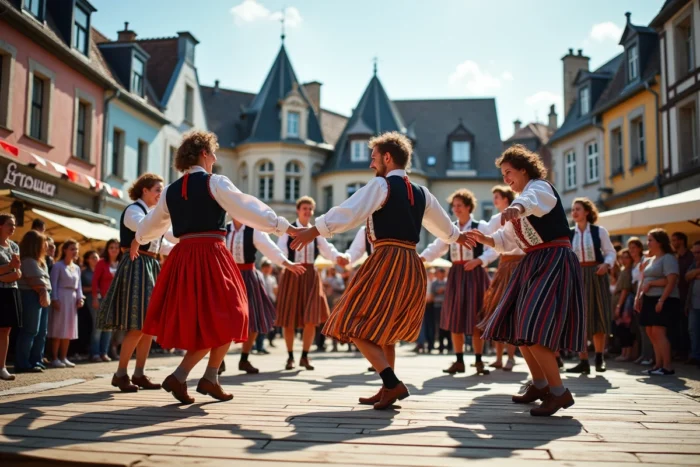
The festival agenda structures a large part of Breton cultural news between May and November. Three events illustrate distinct positions.
Festival des Brodeuses de Pont-l’Abbé
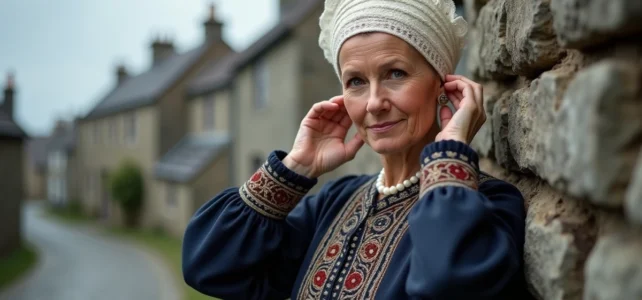
Scheduled from July 9 to 12, 2026, in Pont-l’Abbé (Finistère), this festival remains the main event dedicated to the costume and Bigouden embroidery. Its identity anchoring makes it a strong marker of living Breton culture, focused on the transmission of textile know-how.
Festival de Cornouaille in Quimper
A showcase for bagadoù, Celtic circles, and Breton music, the Festival de Cornouaille is scheduled for 2026 with free access for certain highlights. This partial free access broadens the audience beyond enthusiasts, which alters media coverage: articles focus more on the atmosphere and attendance than on musical analysis.
Celtomania in Nantes: Breton culture beyond administrative borders
The Celtomania 2026 festival takes place in Nantes from October 2 to November 29, featuring two months of Breton and Celtic concerts in Loire-Atlantique. This geographical positioning is significant: Nantes is not part of the administrative Brittany, but the event fully claims the Breton cultural heritage.
This programming outside the region illustrates a phenomenon that Breton tourist portals do not document. Breton culture overflows its administrative perimeter, and online media struggle to reflect this reality when their sections are organized by department.
Breton heritage portals: what Bretania and digitized archives cover
Beyond the daily press, Brittany has digital heritage resources that constitute another layer of cultural news, less visible but more enduring.
- Bretania, the portal for Breton cultures, provides access to digitized collections covering the history of Stade Rennais, the work of Pierre-Jakez Hélias, maritime rescue, and the megalithic site of Gavrinis, which is six thousand years old.
- The departmental archives of Finistère and Morbihan regularly publish photographic and sound collections related to pardons, maritime festivals, and traditional songs.
- Tourist office websites (Kreiz Breizh, Tourisme Bretagne) offer thematic entries by type of heritage but update their content little outside the summer season.
The limitation of these portals lies in their update frequency, often annual or semi-annual. An internet user looking for current Breton news will find archival materials, not fresh news. The complementarity between regional press and heritage portals remains the only way to obtain a complete view.

Breton traditions and media coverage: persistent blind spots
Some aspects of Breton culture remain under-documented online, even by the most active regional media. Three topics illustrate these gaps.
Contemporary Breton dance is the subject of regular evenings in Finistère (the Terre Marine evenings in Tréguenc, for example, celebrate Breton dance every summer), but these local events generate few in-depth articles. Coverage often limits itself to an agenda announcement.
Protected built heritage, particularly within the safeguarded sector of Rennes, is subject to specific legal provisions. Breton media cover major urban planning decisions but rarely the mechanisms of heritage protection themselves.
The collection of oral traditions in Côtes-d’Armor, led by local associations, remains almost invisible in search results. These initiatives feed into Bretania’s collections and constitute a primary source for understanding the evolution of cultural practices.
Online Breton news reflects a culturally dense region, but unevenly documented. Festivals structure the media calendar, heritage portals preserve long-term memory, and the least covered angles concern daily cultural life off-season. Cross-referencing these sources remains the most reliable method to follow what is actually happening on the ground.