
Inclusive behaviors in the workplace are no longer just about an ethical stance or a display of values. The topic is now treated as an issue of psychological health and safety at work, which changes the way organizations approach diversity and inclusion. This evolution encourages a rethinking of practices, not based on general charters, but through concrete measures integrated into decision-making, recruitment, and management processes.
Unconscious biases and governance of processes in the workplace
Most content on inclusion lists benevolent attitudes to adopt among colleagues. The problem is that interpersonal benevolence is not enough when biases are embedded in the processes themselves.
The CCI Paris Île-de-France recommends training decision-makers, managers, and HR leaders to detect unconscious biases. This training is not aimed at inducing guilt, but at making visible the automatic mechanisms that guide choices without our awareness: affinity favoritism in co-optation, confirmation bias during an interview, the tendency to assign visible projects to already dominant profiles.
Among the recommended operational actions, there are measurable governance levers:
- Anonymizing applications to neutralize biases related to name, age, or address, starting from the pre-selection phase.
- Integrating inclusion indicators into HR management (promotion rates by profile, access to training, representation in decision-making committees).
- Structuring evaluation interviews with grids of objective criteria, validated in advance by multiple people.
These practices transform inclusion into a management objective, not just an add-on. Several resources detail these approaches, including examples and advice on Perceptis that address the topic from an operational angle.

Inclusion from the design stage: going beyond the reactive adaptation reflex
The classic approach consists of identifying an obstacle and then proposing an adjustment. A colleague with a disability reports a difficulty, and we adapt their position. An employee who is a caregiver requests a schedule adjustment, and we negotiate on a case-by-case basis.
This reactive logic poses two problems. It places the burden of the request on the affected person. And it treats each situation as an exception, which reinforces the feeling of being apart.
The concept of inclusion from the design stage reverses this logic. It involves integrating the diversity of profiles and needs from the creation of the systems: training paths, digital tools, meeting organization, space arrangements.
Three concrete application areas
In professional training, this means removing access barriers upstream. The ILO emphasizes the recognition of informal and non-formal learning, and complementary support systems for populations distanced from employment. A colleague who does not have a formal diploma but possesses a skill acquired in the field should be able to showcase it without an administrative obstacle course.
In the physical work environment, designing modular spaces (adjustable lighting, quiet zones, visual and tactile signage) benefits everyone, not just people with disabilities.
In internal communication, writing documents in clear and structured language reduces misunderstandings for all teams, not just for individuals with cognitive difficulties or partial mastery of French.
Psychological health and inclusive behaviors in daily life
Linking inclusion to the issues of psychological health and safety changes the game for managers. An environment where some colleagues feel excluded, ignored, or systematically sidelined from decisions generates chronic stress, demotivation, and ultimately absenteeism.
The role of the manager is not limited to organizing work. It also involves spotting informal exclusion dynamics: who never speaks up in meetings, who is never asked for a cross-functional project, who consistently has lunch alone.
Concrete actions at the team level
Actively distributing the floor in meetings by specifically inviting silent individuals to speak, without putting them in a difficult position. Varying contribution formats (written, oral, asynchronous) so that everyone can express themselves according to their working style.
Rejecting ordinary micro-exclusions requires daily vigilance. A joke about an accent, a comment about age, an unconsented nickname: these subtle, repeated signals erode the sense of belonging much more than visible discrimination.
Training managers on these dynamics is not about personal development. It is a lever for preventing psychosocial risks, embedded in the employer’s obligations regarding workplace health.
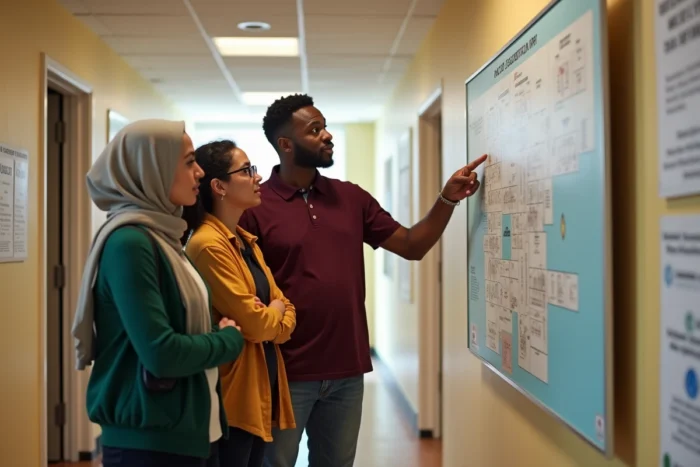
Inclusion indicators: measuring without limiting to quotas
Many companies measure their inclusion policy by the employment rate of people with disabilities or gender parity in leadership bodies. These indicators are useful, but they do not capture the real experiences of employees.
An employee may be counted in a quota and feel deeply excluded. Conversely, a team without visible diversity may operate in a very inclusive manner in terms of practices.
Field feedback varies on this point: some organizations find that an anonymous internal barometer on the sense of belonging provides more actionable information than a purely quantitative dashboard. Others believe that without numerical data, the issue remains invisible to management.
The combination of both approaches seems most relevant: quantitative indicators to objectify gaps, and regular qualitative surveys to understand what teams are actually experiencing. Without this dual perspective, the management of inclusion remains partial.
The challenge for the coming years is less about multiplying actions than about integrating them into the normal functioning of the company. An inclusive behavior that requires a constant effort eventually becomes exhausting. A process designed to be inclusive by default lasts over time.